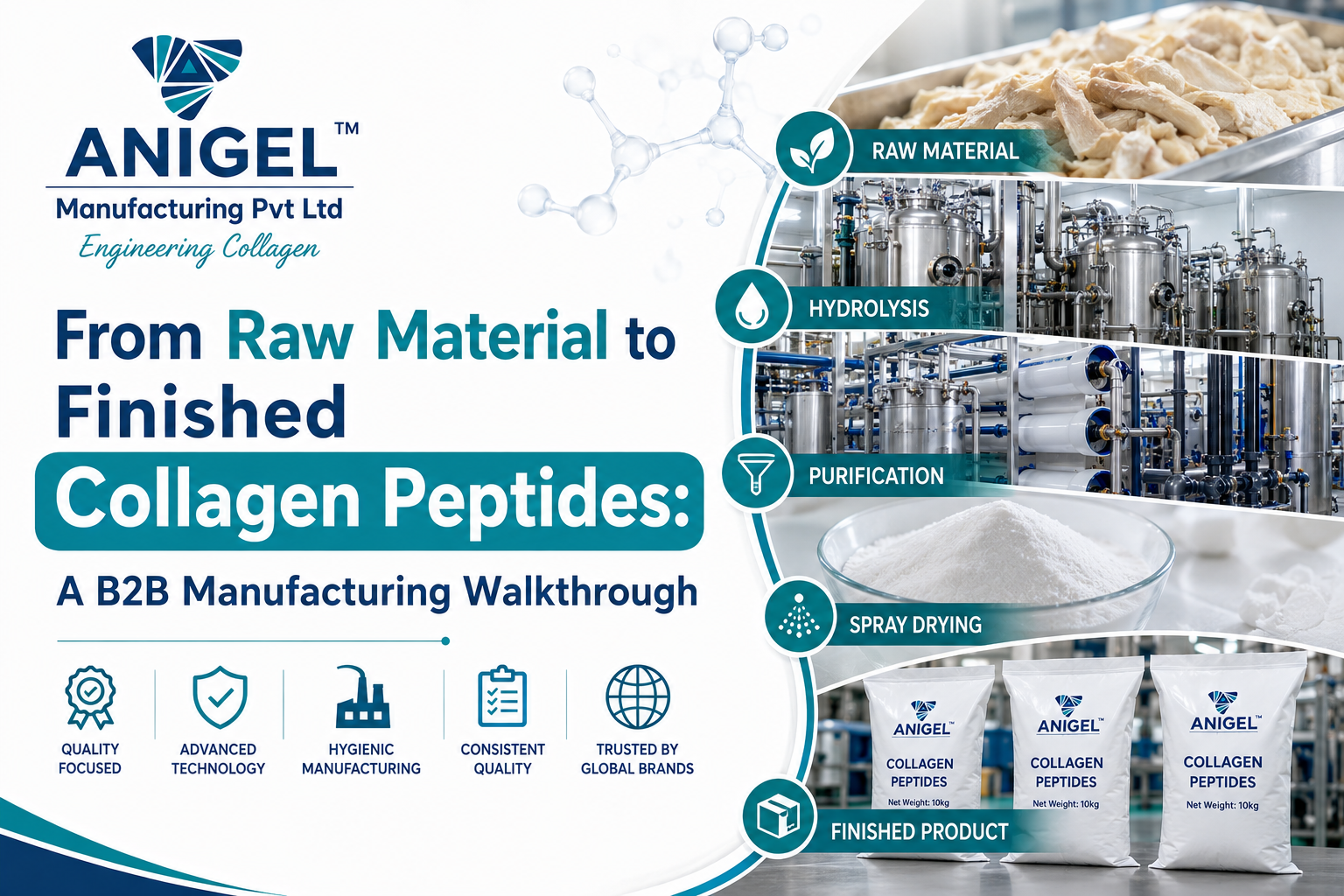
Introduction: Understanding the Collagen Peptide Manufacturing Process
What is the collagen peptide manufacturing process?
The collagen peptide manufacturing process involves converting collagen-rich raw materials into purified collagen and subsequently breaking the protein into smaller peptide chains through controlled hydrolysis. The resulting hydrolysate undergoes downstream processing such as filtration, concentration, and drying before being tested and released as a finished collagen peptide ingredient. For B2B buyers, understanding collagen peptide manufacturing is important because manufacturing conditions can influence molecular-weight distribution, peptide characteristics, solubility, purity, sensory properties, and batch-to-batch consistency. Common collagen sources include bovine, porcine, poultry, and marine materials, including skins, hides, bones, tendons, cartilage, and fish-processing by-products.
The collagen production process involves several carefully controlled stages to transform the selected raw material into high-quality collagen peptides.
How Is Raw Material Selected, Prepared, and Processed for Collagen Peptide Manufacturing?
Raw material selection is the first important control point in collagen peptide manufacturing. The source, quality, traceability, and handling of the material can influence extraction efficiency and downstream processing.
Collagen peptides can be produced from collagen-rich materials such as bovine and porcine skins or hides, bones, tendons, and cartilage, as well as marine sources such as fish skin and scales.
A robust raw-material program generally considers:
- Source and species
- Supplier qualification
- Traceability
- Raw-material specifications
- Storage and handling
- Microbiological quality
- Potential contaminants
- Lot-to-lot consistency
Following approval, raw materials may undergo cleaning, trimming, washing, size reduction and other source-specific preparation steps.
How Does Enzymatic Hydrolysis Convert Collagen into Peptides?
Enzymatic hydrolysis is the controlled breakdown of collagen using proteolytic enzymes that cleave peptide bonds and convert larger protein structures into smaller peptides. It is one of the principal approaches used to produce collagen hydrolysates. Different enzymes have different cleavage specificities. Consequently, enzyme selection is an important part of controlling the collagen peptide hydrolysis process
Why is hydrolysis control important?
The objective is not simply maximum hydrolysis. The manufacturer needs to achieve the desired peptide characteristics consistently.
Important process parameters can include:
- Enzyme type
- Enzyme-to-substrate ratio
- Temperature
- pH
- Reaction time
- Degree of hydrolysis
- Mixing conditions
Research indicates that increasing hydrolysis time can generally shift the peptide profile toward smaller peptides, although the relationship depends on the enzyme and process conditions.
How Is Molecular-Weight Distribution Controlled During Manufacturing?
Molecular-weight distribution of collagen peptides is an important quality attribute because processing conditions, raw-material characteristics, and enzyme specificity can influence the size distribution of the resulting peptides.
Hydrolysis conditions can shift the distribution toward smaller or larger peptide fractions. Manufacturers can therefore influence peptide characteristics by controlling hydrolysis parameters and, where applicable, using separation technologies.
Analytical approaches reported for collagen hydrolysates include:
- Size-exclusion chromatography
- Gel permeation chromatography
- SDS-PAGE
- MALDI-TOF-MS
- LC-MS/MS
These techniques can provide information about the molecular-weight characteristics of collagen hydrolysates.
How Are Collagen Peptides Filtered, Purified, Concentrated, and Dried?
Membrane-based approaches can be used to influence molecular-size fractions during collagen hydrolysate production. Filtration, purification, concentration, and drying help transform the hydrolyzed collagen solution into a stable finished ingredient while supporting the required purity and physical specifications. After hydrolysis, the process stream can contain peptides with different molecular sizes and other soluble or suspended components.
Depending on the manufacturing process, downstream operations may include:
Filtration: Removes suspended particles and unwanted material.
Membrane separation: Can help separate peptide fractions according to molecular size.
Purification: Supports removal or reduction of unwanted components.
Concentration: Reduces water content before drying.
Drying: Converts the concentrated hydrolysate into a stable powder.
How Are Finished Collagen Peptides Tested for Quality, Purity, and Safety?
Collagen peptide testing typically evaluates the finished ingredient against predefined specifications covering identity, composition, peptide characteristics, physical properties, microbiological quality, and relevant contaminants.
Depending on the product and application, quality parameters may include:
Analytical methods such as chromatography and mass spectrometry can be used to characterize collagen peptide molecular-weight profiles.
How Do Manufacturers Ensure Batch-to-Batch Consistency and Traceability?
Manufacturers maintain collagen peptide batch consistency by controlling raw-material inputs, critical processing parameters, analytical testing, and documentation throughout production. A robust system can connect:
Approved raw material → Incoming inspection → Batch identification → Controlled processing → In-process monitoring → Finished-product testing → Batch release
Critical parameters can include hydrolysis conditions, temperature, pH, reaction time, filtration conditions, concentration, and drying parameters. Traceability is equally important. Each finished batch should be connected to relevant manufacturing and raw-material records so that deviations can be investigated and addressed.
For B2B buyers, useful questions include:
- Is each batch traceable?
- Are raw materials sourced from approved suppliers?
- Is molecular-weight distribution routinely tested?
- Are batch-specific COAs provided?
- Are critical manufacturing parameters documented?
- How are deviations managed?
These controls help transform collagen peptide manufacturing from a simple production activity into a controlled quality system.
Why Choose Anigel Manufacturing Pvt. Ltd. for Collagen Peptides?
A suitable collagen peptide manufacturer should combine controlled manufacturing, raw-material traceability, quality testing, technical documentation, and the ability to deliver consistent product specifications.
Anigel Manufacturing Pvt. Ltd. states that its collagen peptide manufacturing capabilities are built around CSIR-CLRI-derived extraction and hydrolysis expertise, further refined through in-house process development. The company also states that it supports traceable sourcing and batch consistency.
Anigel's published information identifies:
- CSIR-CLRI technology
- Traceable bovine and marine sourcing
- FSSC 22000
- Halal and Kosher certification
- US FDA-registered facility
- Batch traceability
- COA, MSDS and TDS documentation
- B2B and custom formulation support
For companies evaluating a collagen peptide manufacturer in India, these capabilities can be relevant when assessing manufacturing transparency, documentation, and supply consistency. Ultimately, the right B2B supplier should be evaluated not only on the finished powder but on the complete system behind it, from raw-material qualification and hydrolysis control to testing, traceability, and batch release.
Frequently Asked Questions About Collagen Peptide Manufacturing
How are collagen peptides manufactured?
Collagen peptides are manufactured by processing collagen-rich raw materials and using controlled hydrolysis to break collagen into smaller peptide chains. The hydrolysate is subsequently filtered, concentrated, dried, and tested before release as a finished ingredient.
What raw materials are used to make collagen peptides?
Common raw materials include bovine, porcine, poultry, and marine collagen-rich materials such as skins, hides, bones, tendons, cartilage, and fish-processing by-products.
What is enzymatic hydrolysis in collagen peptide manufacturing?
Enzymatic hydrolysis uses proteolytic enzymes to break peptide bonds in collagen or collagen-derived protein, producing smaller peptide chains. Enzyme selection and reaction conditions influence the resulting peptide profile.
Why does molecular-weight distribution matter?
Molecular-weight distribution describes the range of peptide sizes present in the collagen peptide ingredient and is influenced by raw materials, enzymes, and hydrolysis conditions. Analytical methods such as size-exclusion chromatography can be used to characterize this distribution.
How is collagen peptide quality tested?
Collagen peptide quality is evaluated using a combination of identity, composition, molecular-weight, physical, microbiological, and contaminant testing. The exact testing panel should correspond to the product specification and intended application.
How do manufacturers ensure batch-to-batch consistency?
Batch consistency is achieved through qualified raw materials, standardized processing conditions, in-process controls, finished-product testing, documentation, and traceability. These controls help ensure that successive production batches remain within established specifications.